
Maritime Risk Strategy 4.
The Arctic Gamble
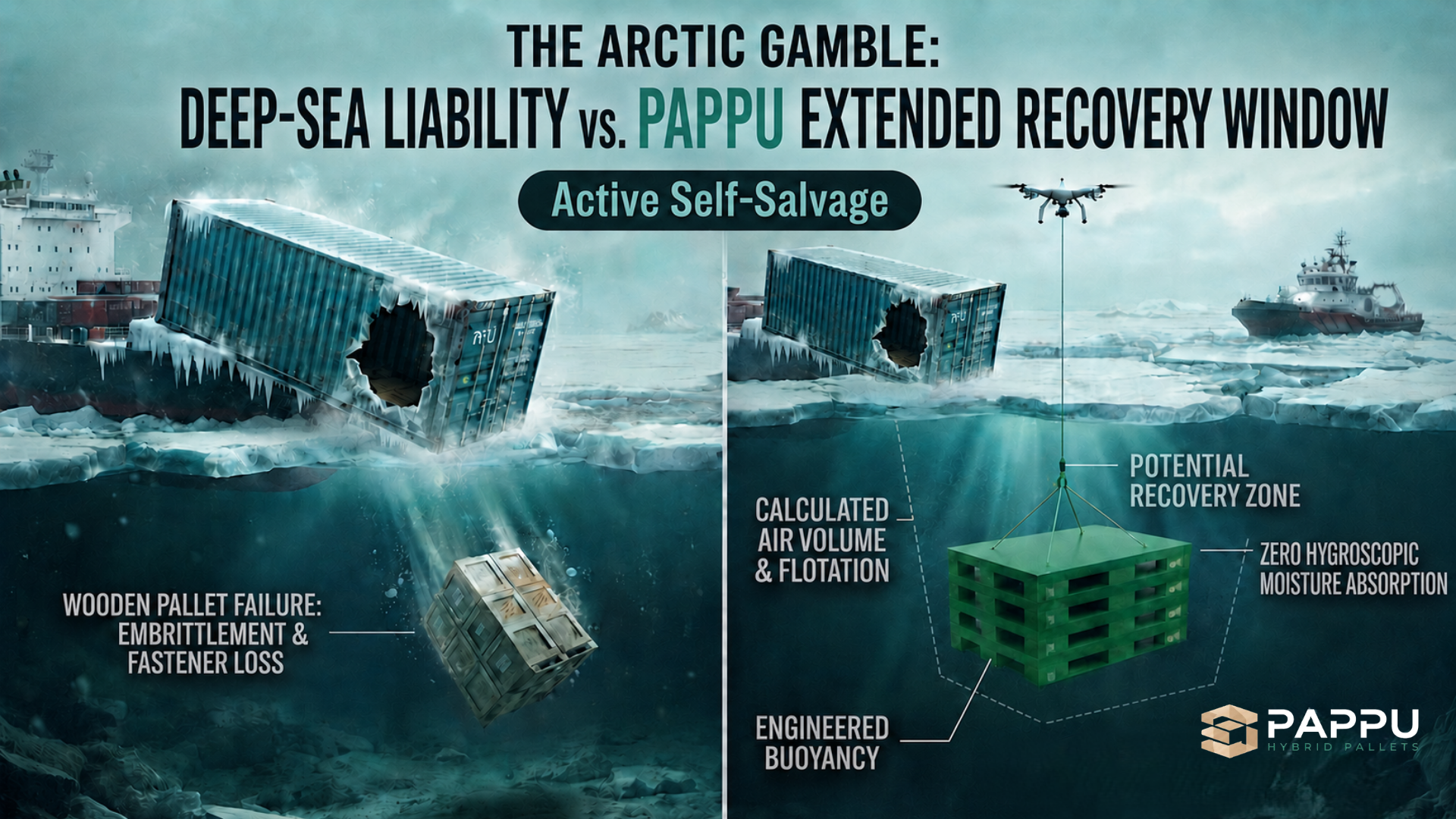
As the Northern Sea Route acts as a merciless micro-logistical filter, traditional wooden pallets can fail due to extreme temperature gradients, material embrittlement, fastener loosening, and hygroscopic re-wetting, jeopardizing cargo integrity. In this hostile environment, traditional insurance models are inadequate; if a container sinks in icy waters, no rescue units are available. Consequently, liability (seabed liability) shifts instantly to the ocean floor and may remain there permanently.
Twentieth-century wood-based technologies are therefore fundamentally incapable of addressing twenty-first-century Arctic challenges. This is precisely where the technological breakthrough bridging passive perception to active engineering defense enters the equation: @PAPPU Hybrid Pallets
Breaking Physical Limits
During the design philosophy of PAPPU pallets, we took careful account of the fact that – among various operational constraints – drastic thermal fluctuations may represent a severe hazard for organic-based, purely wooden or weak plastic structures. Not so in the case of PAPPU pallet.
- Temperature-Independent Stability: Thanks to its advanced hybrid composition, the pallet remains non-brittle and fracture-resistant in freezing Arctic conditions, withstanding continuous dynamic loading and severe transit vibrations.
- Zero Fastener Loosening: Free from the microscopic wear caused by differing thermal expansion rates of metal and wood, all fastenings remain secure and preserve total structural rigidity throughout transit.
- Zero Hygroscopic Moisture Absorption: The pallet does not absorb internal condensation and exterior moisture, completely eliminating mold growth and packaging dampness upon arrival.
Active Engineering Safety and Self-Salvage
The PAPPU pallet is an active safety instrument in Arctic logistics that directly resolves catastrophic scenarios discussed previously:
- Engineered Buoyancy: If a container breaches or capsizes in Arctic waters, the PAPPU pallets’ physical architecture drastically reduces the cargo’s uncontrolled sinking velocity.
- Calculated Air Volume and Floatation: An aggregate net internal air volume of 840 liters from 14 pallets inside a standard TEU container keeps the cargo suspended near the surface or beneath the ice sheet for a sustained period.
- Targeted Recoverability: This technology keeps the cargo within reach of surface rescue zones, preventing deep-sea waste and shielding companies from severe environmental penalties.
Conclusion
The challenges of the Northern Sea Route show that competitive advantage and safety stem from structural resilience and technological self-salvage. Deploying PAPPU pallets can prevent micro-level cargo damage while minimizing the financial and legal risks of macro-level maritime catastrophes.
We invite @MSC, @Maersk, @CMA CGM, and @COSCO
